
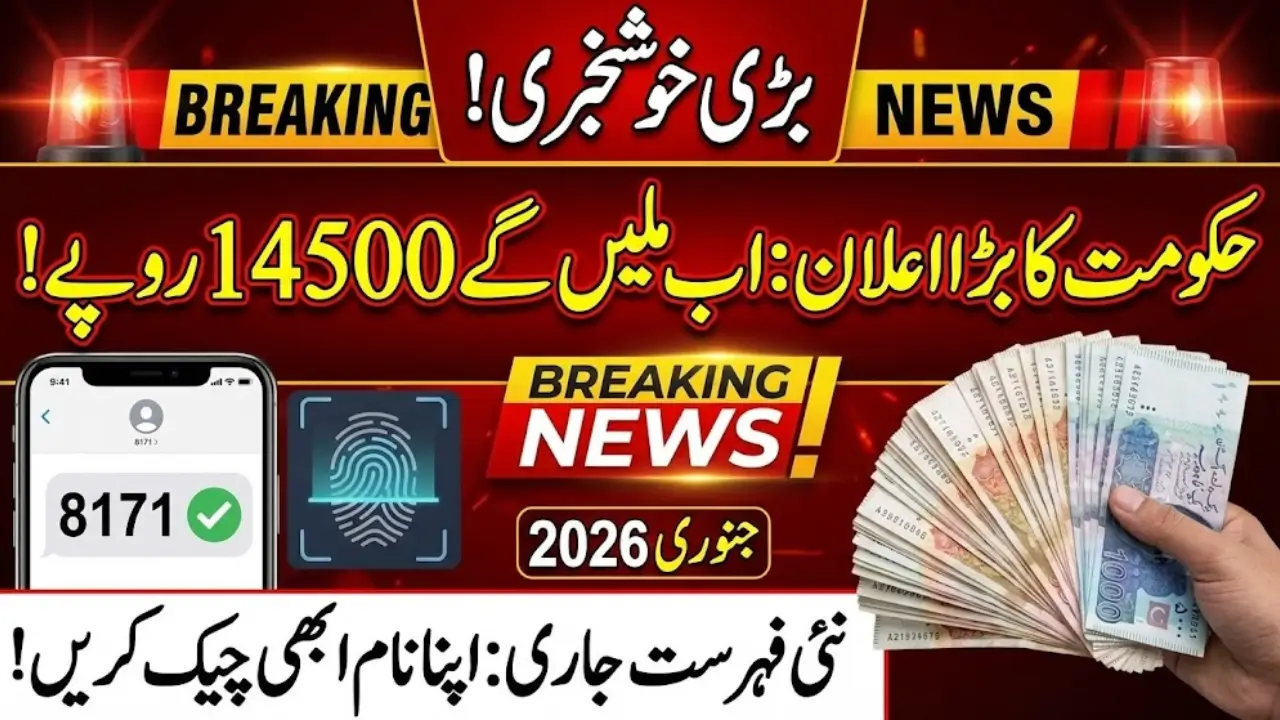
Benazir Income Support Programme, has been a lifeline for thousands of low-income families across Pakistan. As the year 2026 begins, the government has announced a significant update for the programme an increase in the quarterly payment. This new measure is designed to provide extra financial relief to families struggling with rising costs of living, ensuring they can meet their basic needs more comfortably.
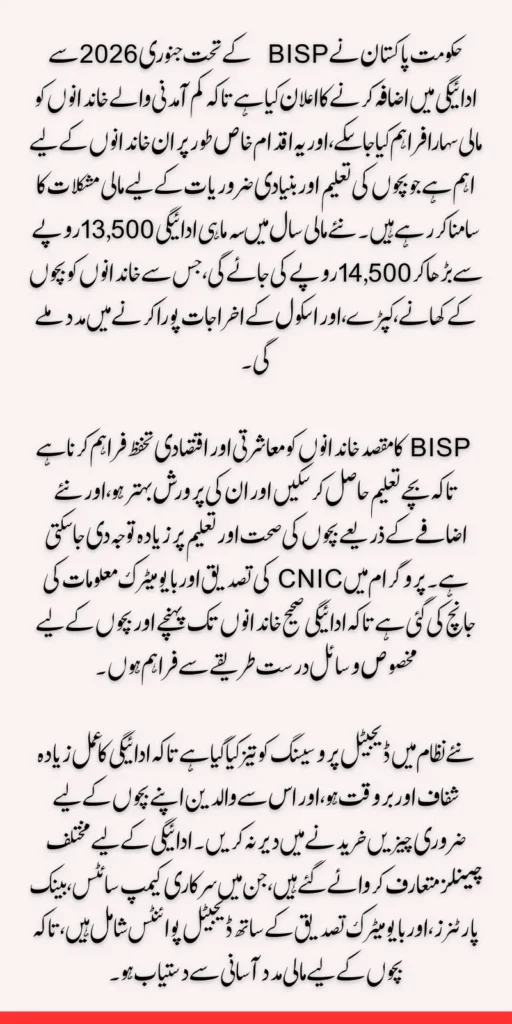
The BISP 8171 payment system is specifically designed to make the disbursement process transparent, efficient, and easily accessible for every verified beneficiary.
Official Announcement for January 2026 Payments
According to government notifications, the BISP will begin implementing the revised payment structure starting January 2026. Beneficiaries under the Benazir Kafaalat Programme will receive an increased quarterly payment of 14,500 PKR instead of the previous 13,500 PKR.
You can also read: Door-to-Door Teams for PSER Survey 2026
This increase is aimed at assisting families in covering essential expenses such as groceries, transportation, utilities, and children’s education while countering the effects of inflation. Moreover, the authorities have emphasized that stronger verification and faster processing will ensure the benefits reach the intended recipients without unnecessary delays.
New Payment Amount Details
The key change in 2026 revolves around the payment increase:
- Previous amount: 13,500 PKR per quarter
- New amount (from January 2026): 14,500 PKR per quarter
- Increase: 1,000 PKR per quarter
This adjustment, though seemingly small, is significant for households managing tight budgets. The additional amount can help families manage essential needs more effectively.
Key Changes in 2026
Increased Payment Amount
The increase to 14,500 PKR per quarter ensures beneficiaries have slightly more financial flexibility. This step demonstrates the government’s commitment to supporting the vulnerable sections of society.
Stronger Verification Requirements
BISP is enhancing its screening process to ensure payments reach the correct families:
- Updated CNIC verification
- Mandatory biometric confirmation
- Re-checking household data
- Correcting family details through the Dynamic Survey
Faster Digital Processing
With a new digital system, beneficiaries can expect:
- Quick payment generation
- Real-time status updates
- Rapid complaint resolution
This improvement aims to reduce the long waiting times seen in earlier cycles.
Improved Payment Channels
Payments will now be distributed through multiple secure channels:
- Government-designated campsites
- Bank partners
- Digital withdrawal points with biometric verification
The goal is to reduce overcrowding and prevent fraud.
Updated Dynamic Survey Rules
The Dynamic Survey remains compulsory for:
- New applicants
- Families with changed data
- Beneficiaries flagged for review
Completing this survey is essential to avoid any payment delays in 2026.
How to Receive the New Payment
Step 1: Check Eligibility
Beneficiaries can confirm their eligibility using:
- Sending CNIC to 8171
- Checking online via BISP portal
- Visiting local BISP office
Eligibility confirmation is essential before receiving the increased amount.
Step 2: Complete or Update Dynamic Survey
Update your information if required by:
- Visiting nearest BISP office
- Visiting nearest NADRA center
Carry CNIC, children’s B-forms, and household details.
Step 3: Verify CNIC and Biometric Info
Ensure:
- CNIC is valid
- Fingerprints match the system
- Family details are correct
This step prevents payment interruptions.
Step 4: Collect Payment
Once distribution starts:
- Visit authorized payment point
- Present original CNIC
- Complete fingerprint verification
- Take receipt after collection
No fees are required at any stage.
Step 5: Report Issues
If any issue arises, such as:
- Payment not showing
- Biometric failure
- Incorrect data
Report immediately at local BISP office or helpline.
You can also read: Green Tractor Scheme Phase II Offline Registration
Payment Channels and Methods
BISP has expanded its payment points to ensure accessibility:
- Authorized Payment Points: Local BISP campsites
- Bank Partners: Selected commercial banks
- Digital Withdrawal Points: Biometric verification ensures security
These channels help prevent fraud, long queues, and confusion during payment collection.
Dynamic Survey Importance
The Dynamic Survey plays a crucial role in ensuring payments reach eligible families. Families who fail to update the survey risk delayed or blocked payments. Key points include:
- Mandatory for new applicants
- Compulsory if household data changes
- Ensures correct targeting of beneficiaries
Updating survey information promptly is vital for smooth payment collection.
Verification and Eligibility Checks
BISP’s enhanced verification process includes:
- CNIC confirmation
- Biometric fingerprint checks
- Household data re-checks
These steps are essential to prevent misuse and ensure transparency.
Digital Processing Improvements
The 2026 BISP system promises:
- Faster payment generation
- Quick status updates via portal
- Efficient complaint handling
This ensures that beneficiaries no longer face delays and can track their payments easily.
Benefits of the Payment Increase
Increasing the BISP payment to 14,500 PKR per quarter offers several advantages:
- Provides financial relief for essential needs
- Helps families manage inflation-related expenses
- Strengthens long-term social protection for vulnerable households
This increase, along with system improvements, reflects the government’s dedication to social welfare.
Challenges and Solutions
Previous payment cycles faced delays and verification issues. The 2026 system addresses these challenges by:
- Implementing stronger verification
- Enhancing digital processing
- Expanding authorized payment channels
This ensures a more reliable and timely payment process.
Old vs. New Payment System
| Feature | Old System (2025) | New System (2026) |
|---|---|---|
| Quarterly Payment Amount | 13,500 PKR | 14,500 PKR |
| Verification | Basic CNIC check | CNIC + Biometric + Data |
| Payment Channels | Limited camps | Camps + Banks + Digital |
| Dynamic Survey | Optional/partial | Mandatory for updates |
| Processing Speed | Moderate | Fast digital system |
Tips for Beneficiaries
- Keep CNIC and household documents updated
- Complete Dynamic Survey on time
- Visit authorized payment points
- Verify all biometric information before collection
- Report issues promptly to avoid delays
Conclusion
The BISP January 2026 payment increase is a vital step toward supporting Pakistan’s vulnerable families. With the quarterly payment rising from 13,500 PKR to 14,500 PKR, households will receive much-needed financial relief for essentials such as food, transport, and utilities. By completing the Dynamic Survey, verifying CNIC and biometric data, and following official instructions, beneficiaries can ensure they receive the updated amount efficiently.
You can also read: 25 December 2025 Holiday Notification Check
This update reflects the government’s ongoing commitment to social protection programs, transparency, and timely support for those in need.
Frequently Asked Questions (FAQs)
- What is the new BISP payment amount for January 2026?
The payment will increase from 13,500 PKR to 14,500 PKR per quarter. - Who is eligible for the January 2026 BISP payment increase?
Active beneficiaries with verified CNIC, updated family data, and completed Dynamic Survey. - How can I check my BISP payment status?
Send CNIC to 8171, check online via the BISP portal, or visit your local BISP office. - Do I need to pay any fee to receive the increased payment?
No. Payments are free, and you should never pay anyone for disbursement. - What should I do if my payment is delayed?
Contact your local BISP office or the official helpline. Do not rely on third-party agents.