

Real Estate Investment Trusts, commonly known as REITs, are becoming one of the most talked-about investment vehicles in Pakistan. With growing urbanization, rising property demand, and improved regulations, REITs are slowly transforming how people participate in real estate investments.
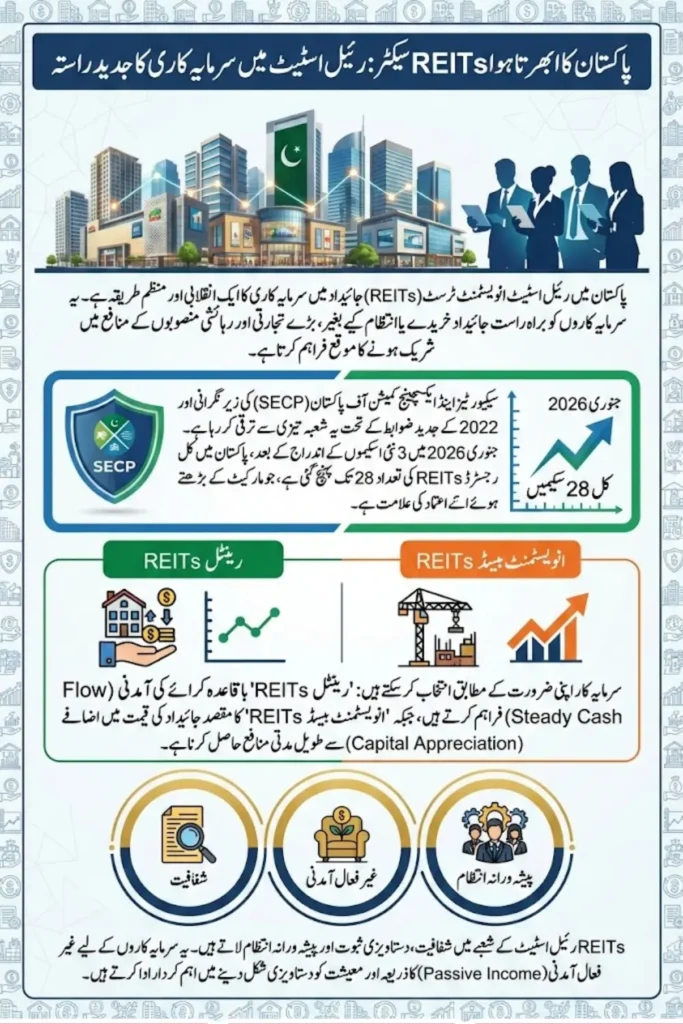
Instead of buying property directly, investors can now invest in professionally managed real estate portfolios through REITs. This opens the door for individuals and institutions to earn income from real estate without dealing with construction, maintenance, or tenant management.
What is a REIT?
A REIT is a company or trust that owns, operates, or finances income-generating real estate.
REITs typically invest in:
- Commercial buildings
- Shopping malls
- Office spaces
- Residential projects
- Warehouses and logistics parks
They generate income mainly from rent or property value appreciation and distribute profits to investors.
You can also read: Apna Khet Apna Rozgar Scheme Apply Online
Why REITs Matter for Pakistan’s Economy
REITs introduce structure and professionalism into a traditionally informal sector.
They help:
- Attract institutional investment
- Improve market transparency
- Encourage documentation
- Create new investment channels
SECP’s Role in Strengthening the REIT Sector
The Securities and Exchange Commission of Pakistan (SECP) plays a central role in regulating and developing Pakistan’s capital markets, including REITs.
Through policy reforms and improved regulations, SECP is actively working to make REITs more attractive, safer, and easier to operate.
Overview of SECP
SECP regulates:
- Stock markets
- Mutual funds
- Insurance companies
- Corporate entities
- REIT schemes
Its goal is to protect investors while promoting sustainable market growth.
Regulatory Improvements Under REIT Regulations 2022
The revamped REIT Regulations 2022 introduced:
- Simplified registration procedures
- Clearer operational guidelines
- Mandatory listing timelines
- Stronger governance standards
These reforms aim to increase investor confidence and market participation.
January 2026 – A Milestone for Pakistan’s REIT Industry
January 2026 marked another positive step for Pakistan’s REIT market as SECP registered three new REIT schemes.
This development signals strong momentum in the sector.
Three Newly Registered REIT Schemes
The newly registered schemes include:
- Two Rental REIT schemes
- One Investment-Based REIT scheme
All are approved under the updated 2022 regulations.
Total Registered REIT Schemes Reach 28
With these additions:
- Total REIT schemes = 28
- Market depth continues to improve
- More choices become available for investors
Understanding Rental REIT Schemes
Rental REITs focus on properties that generate regular rental income.
These schemes are designed for investors seeking steady cash flow rather than speculative gains.
How Rental REITs Work
Rental REITs:
- Acquire completed properties
- Lease them to tenants
- Collect rental income
- Distribute profits to investors
Income Generation Model
Income usually comes from:
- Monthly rents
- Long-term lease contracts
- Periodic rent escalations
This creates predictable income streams.
Understanding Investment-Based REIT Schemes
Investment-Based REITs primarily aim for capital appreciation rather than regular rental income.
These schemes may invest in:
- Development projects
- Under-construction properties
- Strategic land acquisitions
Capital Appreciation Explained
Profits are earned when property values increase and assets are sold at higher prices.
Long-Term Wealth Creation
These REITs suit investors who:
- Have long-term horizons
- Can tolerate volatility
- Seek higher growth potential
You can also read: CM Punjab Laptop Program Portal Live Good News
Key Differences Between Rental and Investment-Based REITs
| Feature | Rental REIT | Investment-Based REIT |
|---|---|---|
| Main Objective | Regular income | Capital growth |
| Risk Level | Lower | Higher |
| Income Type | Rental yield | Price appreciation |
| Investor Profile | Conservative | Growth-oriented |
Purpose
Rental REITs focus on stability, while Investment-Based REITs target expansion.
Risk and Return Profile
Higher risk generally comes with higher potential returns.
Who Can Invest in These REIT Schemes
Initially, these schemes can raise funds from accredited investors.
Accredited Investors
- Financial institutions
- Corporates
- Insurance companies
- High net-worth individuals
Why Accreditation Matters
Accredited investors:
- Understand financial risks
- Have sufficient capital
- Can absorb potential losses
Mandatory Listing Requirement Explained
Both rental and investment-based REIT schemes must be listed within one year of property transfer.
One-Year Listing Rule
This ensures:
- Faster market access
- Greater transparency
- Price discovery
Benefits of Early Listing
- Liquidity for investors
- Public visibility
- Better governance
How REIT Schemes Raise Funds
REITs raise funds by offering units to investors.
Fundraising Mechanism
- Private placement
- Public offering after listing
- Institutional subscriptions
Investor Participation
Investors purchase units and become beneficiaries of income and gains.
Growth of Pakistan’s REIT Sector
The REIT sector has shown steady expansion over recent years.
Recent Trends
- Rising registrations
- Growing institutional interest
- Increased awareness
Market Confidence
More developers and investors are trusting REIT structures.
Structural Reforms Through REITs
REITs introduce discipline into real estate markets.
Documentation
- Legal titles
- Verified ownership
- Proper contracts
Transparency
- Audited financials
- Public disclosures
- Regulatory reporting
Governance and Investor Protection
Strong governance is a cornerstone of REIT regulations.
Regulatory Oversight
SECP monitors:
- Compliance
- Reporting
- Operations
Risk Management
- Independent trustees
- Professional managers
- Asset valuation checks
Benefits of REITs for Investors
REITs offer multiple advantages.
- Passive income
- Lower entry barrier
- Diversification
- Professional management
Passive Income
Investors earn without managing properties.
Portfolio Diversification
Real estate exposure balances stock and bond investments.
Benefits of REITs for Real Estate Industry
REITs modernize the sector.
- Formalization
- Institutional funding
- Project quality improvement
Formalization
Informal practices gradually reduce.
Professional Management
Projects are run by experts.
Challenges Facing REITs in Pakistan
Despite progress, challenges remain.
Awareness Issues
Many investors still lack understanding.
Market Volatility
Economic fluctuations affect property values.
Future Outlook of REIT Market in Pakistan
The future looks promising.
Expansion Opportunities
- More sector-specific REITs
- Infrastructure-focused REITs
- Residential REITs
Long-Term Vision
REITs may become mainstream investment tools.
Step-by-Step Guide to Investing in REITs
- Learn about REIT types
- Review financial reports
- Compare returns
- Choose suitable scheme
- Invest through authorized channels
Research
Study performance and management quality.
Selection
Match REIT with goals.
Investment
Allocate funds wisely.
You can also read: Hunarmand Naujawan Parwaaz
Important Considerations Before Investing
- Risk tolerance
- Investment horizon
- Income vs growth preference
Risk Assessment
Understand potential losses.
Investment Goals
Define objectives clearly.
Conclusion
The registration of three new REIT schemes in January 2026 reflects the growing maturity of Pakistan’s REIT market. With strong regulatory backing, clearer rules, and increasing investor participation, REITs are shaping a more transparent and structured real estate sector. For investors, REITs provide an accessible gateway to property investment, offering both income and growth opportunities. As awareness increases and more schemes enter the market, REITs are set to become a cornerstone of Pakistan’s capital market ecosystem.
FAQs
1. What is the minimum investment in REITs?
It depends on the scheme and offering structure.
2. Are REITs safer than direct property investment?
They offer better transparency and regulation.
3. Can individuals invest in REITs?
Yes, once schemes are publicly listed.
4. Do REITs pay regular income?
Rental REITs typically distribute periodic income.
5. Are REIT returns guaranteed?
No, returns depend on market performance.