
Khyber Pakhtunkhwa has taken a major stride toward educational reform with the cabinet’s approval of the E-Transfer Policy 2025 for teachers an initiative designed to digitize, standardize, and depoliticize the transfer process. This reform aligns with the provincial government’s broader vision of establishing transparent governance mechanisms across all departments. By replacing traditional recommendation-based transfers with a centralized digital system, the policy aims to restore trust among educators and ensure fair posting decisions.
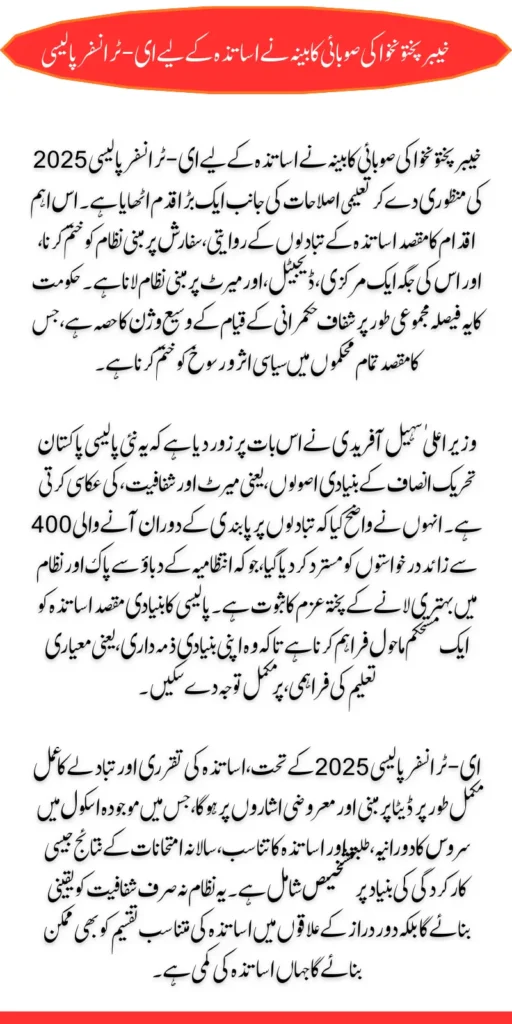
Chief Minister Sohail Afridi emphasized that the new policy reflects the founding principles of merit upheld by Pakistan Tehreek-e-Insaf. He noted that despite receiving more than 400 posting requests during the province-wide transfer ban, none were entertained—signaling the administration’s commitment to ending undue influence and prioritizing systemic improvement. According to him, a stable work environment will finally allow teachers to refocus on their fundamental mandate: providing quality education.
Key Features of the E-Transfer Policy 2025
The E-Transfer Policy 2025 introduces a structured, data-driven approach that evaluates teachers based on objective indicators. This not only eliminates opportunities for favoritism but also helps redistribute resources where they are needed most. The inclusion of welfare-based categories ensures that teachers dealing with personal hardships are accommodated fairly.
Major Components at a Glance
- Digital application and evaluation through a centralized portal
- Weightage for years served in the current school
- Consideration of student–teacher ratios to address staffing gaps
- Performance-based indicators such as annual examination results
- Additional support categories: disability, widowhood, separation cases, and spouse placement
- Province-wide compliance under a uniform merit policy
You can also read: Alleged Mismanagement During BISP
Merit Indicators Used in E-Transfer Evaluation
| Indicator Category | Description | Weightage |
|---|---|---|
| Service Duration | Years served in current school | Medium |
| Student–Teacher Ratio | Priority for understaffed schools | High |
| Academic Performance | Annual student result outcomes | Medium |
| Social Hardship Cases | Disability, widowhood, separation, spouse posting | Variable |
Ensuring Fairness Through Digitization
By shifting to a fully automated system, the KP government aims to minimize manual intervention and eliminate the long-standing culture of political recommendations. The model evaluates each application through preset criteria, making outcomes predictable and easier to audit. Teachers can track their application status online, enhancing transparency while reducing unnecessary visits to district or provincial offices.
Moreover, the standardized digital approach ensures that resources are allocated more equitably across urban and rural areas. Schools suffering from teacher shortages—especially in remote regions can be prioritized automatically without bureaucratic delays. This balanced distribution is expected to improve both instructional quality and student learning experiences across the province.
Policy Benefits for Teachers and Schools
- Clear, rule-based decisions with no hidden processes
- Faster, more efficient postings and transfers
- Reduced political pressure on teachers and administrators
- Better distribution of subject specialists across the province
- Stress reduction for teachers facing personal and family difficulties
Teacher Support Categories and Their Policy Impact
| Category | Eligibility | Policy Benefit |
|---|---|---|
| Disability | Teachers with verified physical/medical disabilities | Priority consideration in placement |
| Widowhood | Widowed female teachers | Special weightage for compassionate transfer |
| Separation Cases | Spouses working in different districts | Posting priority to enable family reunion |
| Husband/Wife Posting | Government-employed spouses | Aligned placement for household stability |
A Model for Other Departments
Chief Minister Sohail Afridi has directed all provincial departments to replicate the e-transfer mechanism, signaling a province-wide shift toward digital governance. According to him, sectors such as health and education form the backbone of public welfare, and any weaknesses in these institutions directly harm the future of the province. Ensuring strong, transparent systems is therefore essential to long-term development.
You can also read: Punjab Government Crackdown on Illegal Hotels and Encroachments
As KP continues to digitize its operations, the Education Department’s success with the 2025 E-Transfer Policy may serve as a blueprint for reforming other government functions. Its focus on meritocracy and accountability is expected to elevate institutional efficiency while restoring public confidence in administrative processes.