

Punjab has taken a bold and future-focused step by announcing Artificial Intelligence (AI) as a mandatory subject in all state-run schools. This decision represents a major shift in how education is viewed and delivered across the province. Instead of relying only on traditional subjects, Punjab is now preparing students for a world that is rapidly shaped by technology and automation.
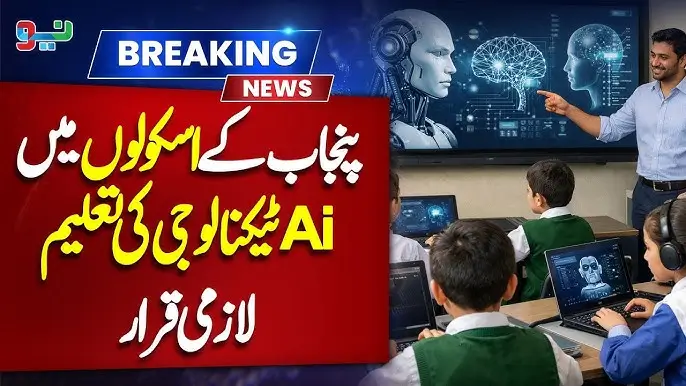
This initiative is not just about adding a new subject. It is about changing mindsets, building digital confidence, and equipping students with skills that will remain relevant for decades. As industries worldwide move toward intelligent systems, students in Punjab will no longer be left behind.
Why AI Education Matters Today
Artificial Intelligence is already part of daily life. From smartphones and navigation apps to online shopping and voice assistants, AI quietly powers many tools we use.
Teaching AI in schools helps students:
- Understand how technology works
- Develop logical and analytical thinking
- Become creators, not just consumers of technology
Vision Behind the Policy Decision
The government’s vision is simple but powerful: prepare students for the future, not the past. By introducing AI early, Punjab aims to build a generation that is digitally literate, adaptable, and innovative.
You can also read: Chief Minister Maryam Nawaz
Historic Announcement by Punjab Government
The historic declaration was made by Punjab Chief Minister Maryam Nawaz, who emphasized aligning education with global technological trends. According to her, students must become fluent in the language of modern technologies to compete internationally.
This announcement marks a turning point in public education policy, showing a strong commitment to modernization and equal opportunity.
Role of Chief Minister Maryam Nawaz
Her leadership highlights:
- Strong political will for education reform
- Focus on future-ready learning
- Commitment to public-sector schools
Key Objectives of the Initiative
- Democratize access to advanced knowledge
- Bridge digital inequality
- Improve national competitiveness
What Does Mandatory AI Education Mean?
Mandatory AI education means that every government school student will study AI as part of the regular curriculum, just like mathematics or science.
It does not mean students will be forced to become programmers. Instead, they will learn foundational concepts in a simple and understandable way.
Understanding AI in Simple Words
Artificial Intelligence refers to machines or systems that can learn, think, and make decisions similar to humans.
Examples students already know:
- Voice assistants on phones
- Recommendations on YouTube or Netflix
- Face recognition on smartphones
How AI Fits into School Learning
AI will be taught as:
- A concept-based subject
- A tool for problem-solving
- A way to understand modern technology
Staged and Age-Relevant Curriculum Structure
The AI curriculum will be introduced gradually, based on student age and cognitive level. This ensures learning remains stress-free and meaningful.
At this stage, the focus is on thinking skills rather than technology.
Students will learn:
- Logical reasoning
- Pattern recognition
- Step-by-step thinking
- Simple problem-solving
Middle School AI Exposure
Students will begin to understand:
- What AI is
- How machines learn
- How AI is used in everyday life
Secondary and Higher Secondary AI Studies
At higher levels, students explore:
- Real-world AI applications
- Data basics
- Ethical AI use
- Simple project-based learning
Curriculum Design and Content Areas
The curriculum is being developed by education experts, curriculum designers, and subject specialists to ensure quality and relevance.
Core Concepts Covered
- Introduction to AI
- Data and information
- Algorithms (basic level)
- Intelligent systems
Ethical and Responsible AI Use
Students will also learn:
- Fairness in technology
- Privacy and data protection
- Avoiding misuse of AI
You can also read: Punjab Opens Laptop Applications
Integration with Existing Subject
AI will not replace other subjects. Instead, it will support and strengthen them.
AI with Mathematics and Science
- Data interpretation
- Logical problem-solving
- Scientific simulations
AI with Computer Studies
- Digital literacy
- Computational thinking
- Technology awareness
Teacher Training and Capacity Building
Teachers are the backbone of this initiative. Without trained educators, no reform can succeed.
AI Master Trainers Program
Over 1,000 teachers have already been certified as AI Master Trainers.
Their responsibilities include:
- Training other teachers
- Developing lesson plans
- Supporting schools
Recruitment of Specialized AI Teachers
The government plans to:
- Hire AI specialists
- Reduce workload on general teachers
- Ensure subject expertise
Teaching Materials and Learning Resources
High-quality materials are essential for effective learning.
Textbooks and Workbooks
Students and teachers will receive:
- Standardized textbooks
- Practice workbooks
- Teacher guides
Digital and Offline Resources
- Video lessons
- Interactive activities
- Printable worksheets
Infrastructure Development Plan
Not all schools currently have strong digital infrastructure. The government acknowledges this reality.
Current Challenges in Schools
- Limited computers
- Unreliable electricity
- Weak internet connectivity
Government’s Multi-Stage Infrastructure Strategy
- Gradual hardware provision
- Internet expansion
- Smart classroom development
Addressing Digital Divide
One of the main goals is to ensure equality.
Urban vs Rural Education Gap
Students in rural areas often lack access to modern technology. This initiative aims to reduce that gap.
Equal Opportunities for All Students
- Same curriculum
- Same learning goals
- Same quality standards
Benefits for Students
AI education offers multiple advantages.
- Better thinking skills
- Improved creativity
- Confidence with technology
- Career awareness
Skill Development
Students gain:
- Analytical skills
- Problem-solving ability
- Digital literacy
Career Readiness
Early exposure opens doors to:
- Technology careers
- Engineering fields
- Entrepreneurship
Benefits for Teachers and Schools
This reform also supports educators.
Professional Growth
Teachers gain:
- New skills
- Training opportunities
- Career development
Modern Learning Environment
Schools become:
- More interactive
- Technology-friendly
- Student-centered
International Perspective on AI Education
Many countries have already introduced AI literacy in schools.
Global Trends
- Coding in primary schools
- AI awareness programs
- Digital citizenship education
How Punjab Aligns with the World
Punjab’s initiative places Pakistan among forward-looking education systems.
You can also read: Skill Bridge Apprenticeship Batch 2 Applications
Expert Opinions and Professional Analysis
Education experts have largely welcomed the decision.
Why Experts Support the Move
- Future workforce preparation
- Improved innovation capacity
- Economic competitiveness
Long-Term Sustainability
Experts stress the importance of:
- Continuous teacher training
- Curriculum updates
- Strong monitoring
Challenges and Risk Management
No reform is without challenges.
Implementation Risks
- Resource limitations
- Teacher resistance
- Monitoring difficulties
Solutions and Safeguards
- Phased rollout
- Strong supervision
- Feedback systems
Long-Term Impact on Pakistan’s Economy
AI education strengthens national development.
Workforce Transformation
- Skilled labor
- Higher productivity
- Technology-driven jobs
Innovation Culture
- Startups
- Research
- Digital entrepreneurship
A Public Education Defining Step
This reform represents a shift from memorization-based education to skill-based learning.
Students move from passive learning to active problem-solving.
Setting a National Example
Punjab may inspire other provinces to follow.
AI Curriculum Progression Overview
| Education Level | Focus Area | Learning Style |
|---|---|---|
| Primary | Thinking Skills | Activity-Based |
| Middle | AI Awareness | Conceptual |
| Secondary | Applications | Project-Based |
| Higher Secondary | Advanced Concepts | Practical |
Conclusion
Punjab’s decision to mandate Artificial Intelligence as a school subject is a historic and visionary step. It signals a commitment to preparing students for a digital future while promoting equal access to modern knowledge. With careful planning, strong teacher training, and continuous support, this initiative has the potential to reshape education and empower millions of young minds. If implemented effectively, Punjab could become a model for education reform not only in Pakistan but across the region.
Frequently Asked Questions (FAQs)
1. Will students need computers to study AI?
No. Early stages focus on concepts and thinking skills, not heavy computer use.
2. Is programming required for AI subject?
Basic exposure may be included, but advanced programming is not mandatory.
3. Will AI replace computer studies?
No. AI will complement existing subjects.
4. When will the program start?
Implementation will begin in phases across grade levels.
5. Will private schools follow this policy?
The mandate applies to government schools, but private schools may adopt similar models.