
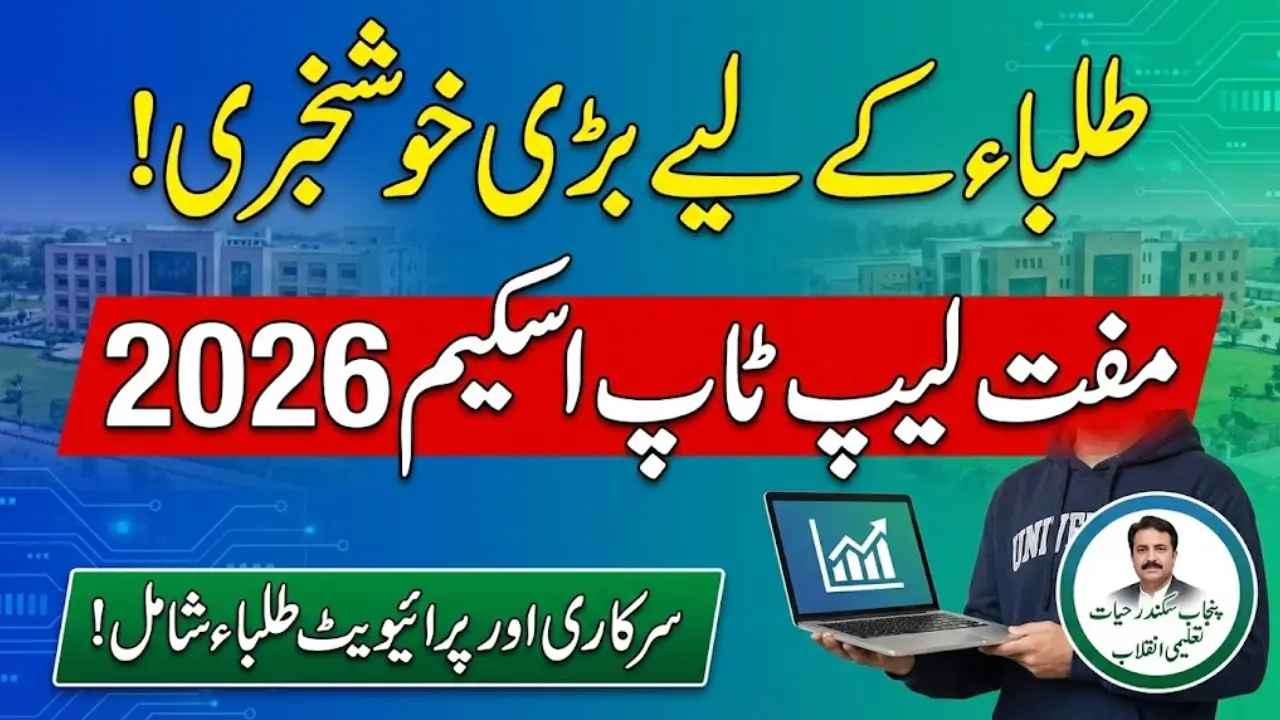
Punjab’s education sector is standing at a turning point, and the government is clearly signaling that change is not just coming it is already in motion. With the declaration of 2025–2026 as a landmark period for education reforms, Punjab Education Minister Rana Sikandar Hayat has laid out an ambitious roadmap aimed at transforming access, quality, and governance across the province.
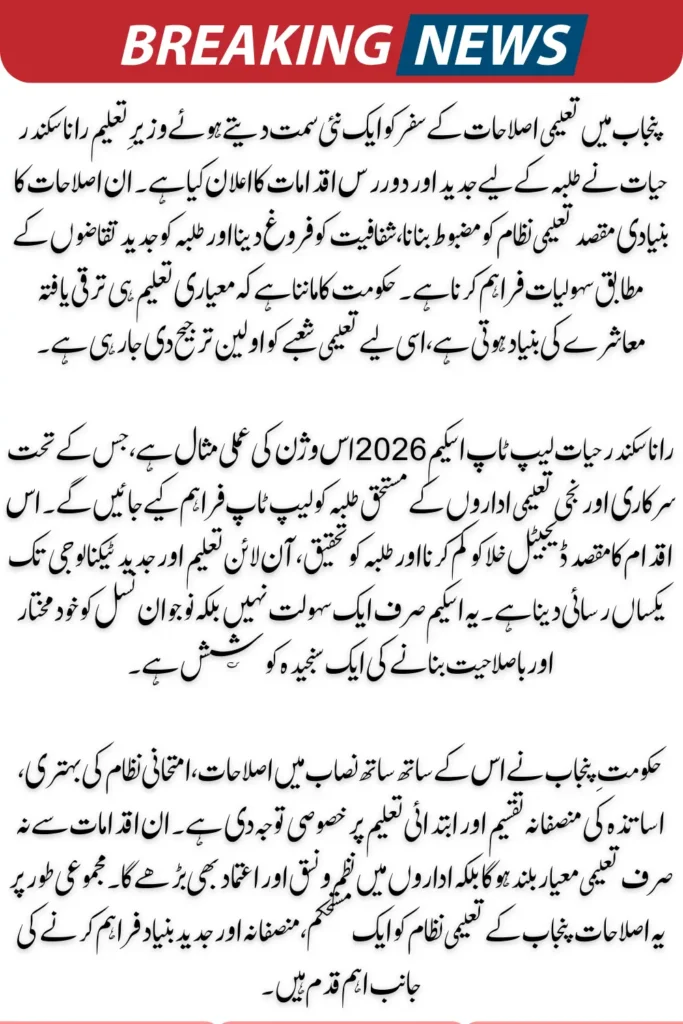
At the heart of this vision lies a simple belief: education should be modern, inclusive, and fair. In a world where digital tools are as essential as textbooks, the government’s renewed focus on technology-driven learning is both timely and necessary. The Laptop Scheme 2026 is one of the most practical steps in this direction, designed to empower students with the tools they need to succeed in a digital age.
Declaring 2025–2026 as the Reform Era
The government has framed these years as a foundation-building phase rather than a short-term political move. Instead of isolated projects, reforms are being introduced as part of a connected system that improves enrollment accuracy, teaching quality, curriculum relevance, and student support.
The Role of Digital Access in Modern Education
Digital access is no longer a luxury. From online research to virtual assessments, students without devices are automatically left behind. This reality explains why laptop distribution has become a central pillar of Punjab’s education reform strategy.
You can also read: Today Silver Price in Pakistan January 01
Who Is Rana Sikandar Hayat?
Rana Sikandar Hayat, serving as Punjab’s Education Minister, has emerged as a reform-focused leader with a strong emphasis on accountability and measurable outcomes. His approach reflects a balance between policy reform and on-ground execution.
Leadership as Punjab’s Education Minister
Under his leadership, the education department has moved away from symbolic announcements toward data-backed decisions. Eliminating inefficiencies, improving transparency, and ensuring merit-based governance are recurring themes in his policy direction.
Policy Direction and Governance Style
Rather than repeating outdated programs, the minister has focused on restructuring existing systems. This includes correcting enrollment data, redistributing teachers, and introducing technology-driven monitoring systems.
Overview of the Laptop Scheme 2026
The Rana Sikandar Hayat Laptop Scheme 2026 is not just another gadget giveaway. It is a targeted initiative designed to support deserving students and align education with modern learning needs.
Why the Laptop Scheme Matters
Laptops open doors to:
- Online learning platforms
- Digital libraries and research journals
- Skill development tools
- Virtual collaboration and communication
By providing laptops, the government is investing directly in student capability rather than temporary incentives.
Expansion to Private Educational Institutions
For the first time, students from private educational institutions are also included. This decision reflects an understanding that talent exists across sectors and support should be based on merit, not institutional labels.
Key Objectives of the Laptop Distribution Program
The scheme has been designed with clear and measurable objectives that go beyond surface-level impact.
Bridging the Digital Divide
Many capable students struggle simply because they lack access to devices. This scheme aims to reduce inequality by ensuring that financial limitations do not restrict academic growth.
Promoting Equal Learning Opportunities
Key goals include:
- Equal access to digital resources
- Encouragement of independent learning
- Support for research-based education
- Preparation for technology-driven careers
You can also read: Double-Decker Buses Resume Service in Karachi
Eligibility Criteria for Students
The eligibility framework is structured to ensure fairness and transparency while reaching students who genuinely need support.
Public Sector Students
Students enrolled in government colleges and universities will be considered based on:
- Academic performance
- Enrollment verification
- Compliance with program guidelines
Private Sector Students
Private institution students are included under:
- Merit-based selection
- Verified academic records
- Institutional recognition by authorities
Number of Laptops and Distribution Plan
The government has announced the distribution of 10,000 laptops under this scheme, with a structured rollout plan.
Allocation of 10,000 Laptops
The allocation is designed to ensure balanced representation across districts, institutions, and academic disciplines.
Transparent Distribution Mechanism
Transparency measures include:
- Digital registration systems
- Verified student data
- Institutional oversight
- Audit and reporting mechanisms
Major Education Reforms Introduced Alongside the Scheme
The laptop initiative is part of a broader reform package rather than a standalone project.
Elimination of Ghost Enrollments
The education department identified and removed nearly 2 million ghost enrollments. This correction has improved data accuracy and redirected resources to real students.
Teacher Rationalization Strategy
Through the rationalization of 26,000 teachers, shortages were addressed without additional hiring, ensuring better teacher distribution across schools.
Historic Syllabus and Examination Reforms
Curriculum and assessment methods have also undergone significant updates.
Modernized Curriculum Framework
The revised syllabus emphasizes:
- Conceptual learning
- Practical application
- Critical thinking
- Skill-based education
Introduction of E-Marking Systems
Shifting examination boards to e-marking systems has:
- Reduced human bias
- Increased result accuracy
- Improved transparency
- Shortened result processing time
Focus on Early Childhood Education (ECE)
Recognizing that learning begins long before formal schooling, the government prioritized Early Childhood Education.
Establishment of ECE Rooms
ECE rooms were set up in 10,000 schools, creating age-appropriate learning spaces that support cognitive and social development.
School Nutrition Program Impact
Under the nutrition program:
- 1.1 million students receive daily meals
- Attendance rates have improved
- Student health and focus have increased
School Infrastructure and Upgradation
Physical learning environments play a crucial role in education quality.
Upgrading 268 Schools
Upgraded facilities include:
- Improved classrooms
- Basic technology integration
- Better sanitation
- Safe learning spaces
Improving Learning Environments
These upgrades help reduce dropout rates and increase student engagement, especially in underserved areas.
Governance, Accountability, and Safety Measures
Educational reform is incomplete without strong governance.
Addressing Harassment Cases
The resolution of 37 harassment cases involving teachers reflects a commitment to safe and respectful educational environments.
Strengthening Institutional Accountability
Clear reporting channels and disciplinary mechanisms have been reinforced to build trust within institutions.
You can also read: State Bank of Pakistan Rolls Out Innovative Index to Measure
Reforms in Higher Education Sector
Higher education has also seen governance improvements.
Merit-Based Appointments in Colleges
Principals were appointed on merit in 450 colleges, reducing political influence and improving academic leadership.
Vice Chancellor Appointments in Universities
The appointment process for vice chancellors in 29 universities has been completed, ensuring administrative stability.
Impact of Laptop Scheme on Students
The real success of the scheme lies in its effect on students’ academic and professional growth.
Academic Performance and Research
Laptops support:
- Research projects
- Online assessments
- Digital note-taking
- Access to global knowledge
Digital Skills Development
Students gain essential skills such as:
- Information literacy
- Software usage
- Online collaboration
- Problem-solving through technology
Comparison with Previous Laptop Schemes
While Punjab has launched laptop schemes before, the 2026 version stands apart.
What’s New in 2026 Scheme
Key differences include:
- Inclusion of private sector students
- Data-verified eligibility
- Integration with broader reforms
- Stronger monitoring systems
Lessons Learned from Past Initiatives
Past challenges such as unequal distribution and outdated criteria have been addressed through improved planning.
Challenges and Implementation Strategy
No reform is without challenges, but planning reduces risk.
Distribution Challenges
Potential challenges include:
- Data verification delays
- Regional logistics
- Institutional coordination
Monitoring and Evaluation
The government plans continuous monitoring through digital dashboards and institutional reporting.
Future of Digital Education in Punjab
The Laptop Scheme 2026 is a step toward a larger vision.
Long-Term Vision Beyond 2026
Future plans include:
- Expanded digital classrooms
- Online teacher training
- Virtual learning platforms
Sustainable Education Reforms
By aligning technology with governance and curriculum reform, Punjab aims to build a sustainable education ecosystem.
Laptop Scheme 2026 at a Glance
| Feature | Details |
|---|---|
| Scheme Name | Rana Sikandar Hayat Laptop Scheme 2026 |
| Total Laptops | 10,000 |
| Eligible Students | Public & Private Institutions |
| Key Objective | Digital Access & Educational Equity |
| Linked Reforms | Curriculum, Exams, Governance |
Conclusion
The Rana Sikandar Hayat Laptop Scheme 2026 represents more than a policy announcementit reflects a shift in how education is perceived and delivered in Punjab. By combining digital access with systemic reforms in curriculum, governance, and early education, the government is addressing root problems rather than surface symptoms. If implemented with consistency and transparency, this initiative has the potential to redefine educational outcomes for thousands of students and set a strong foundation for Punjab’s future.
You can also read: Zewar-e-Taleem Program – Easy Way to Check Status
Frequently Asked Questions (FAQs
1. Is the Laptop Scheme 2026 only for government students?
No, the scheme includes students from both public and private educational institutions based on merit.
2. How many laptops will be distributed under this scheme?
A total of 10,000 laptops will be distributed across Punjab.
3. What makes this laptop scheme different from previous ones?
This scheme includes private students, uses verified data, and is linked with broader education reforms.
4. Will the scheme support digital learning skills?
Yes, the laptops are intended to enhance research, online learning, and digital skill development.
5. Is the laptop scheme part of a larger education reform plan?
Yes, it is integrated with curriculum reforms, teacher rationalization, and governance improvements.